SINTA
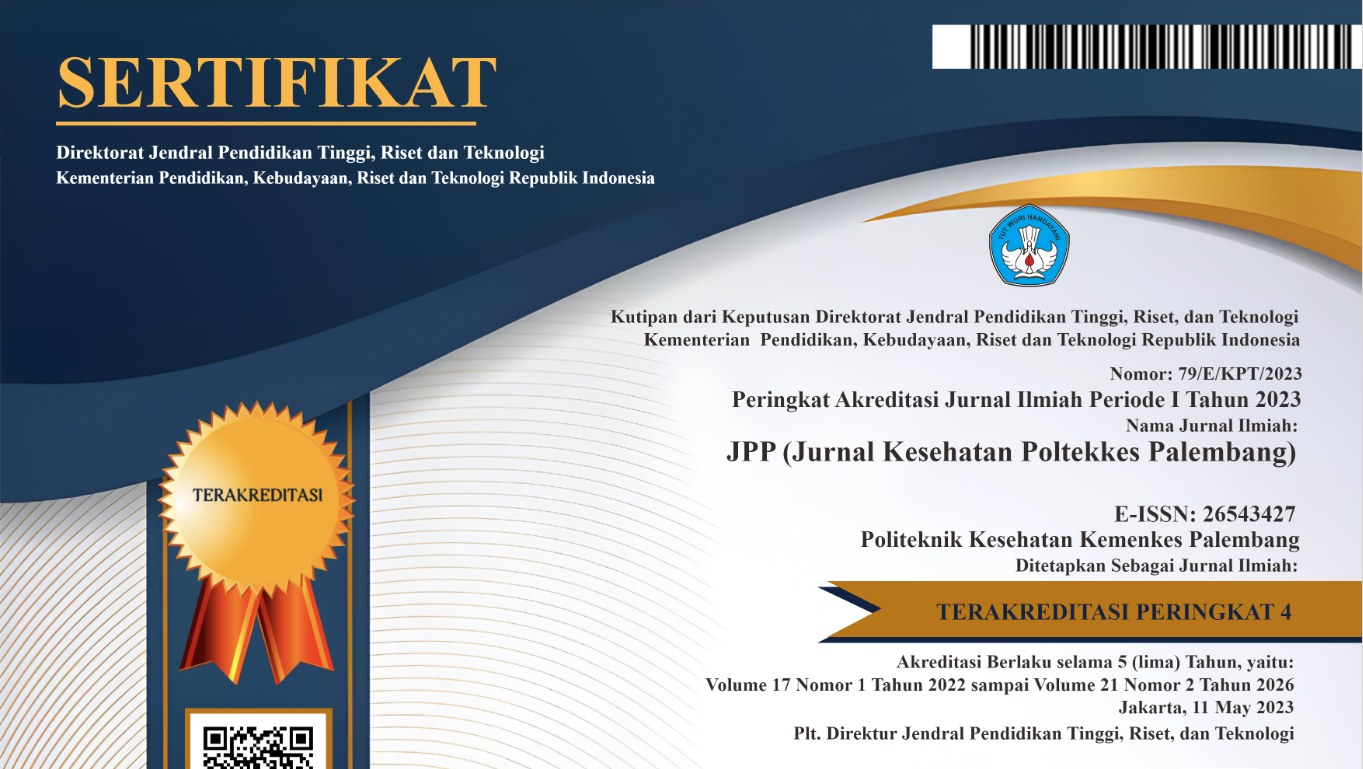

STATISTICS
INDEXED BY





ISSN & E-ISSN
TOOLS


SUPPORTED BY


Jurnal Poltekkes Palembang promotes open, critical, constructive, and evidence-based scholarly dialogue concerning articles published in the journal. Scholarly knowledge develops through continuous evaluation, methodological scrutiny, theoretical debate, and the exchange of diverse perspectives.
Jurnal Poltekkes Palembang welcomes post-publication contributions from researchers, academics, practitioners, policymakers, readers, and other members of the scholarly community that strengthen research quality and publication integrity.
This policy is informed by principles of responsible scholarly communication, including transparency, accountability, fairness, and the ethical guidance of the Committee on Publication Ethics (COPE).
1. Purpose and Scope
This policy establishes procedures for submitting, evaluating, responding to, and publishing scholarly comments or concerns about articles published in Jurnal Poltekkes Palembang.
Its objectives are to:
Facilitate constructive academic dialogue;
Encourage critical assessment of research methods, theoretical frameworks, evidence, and conclusions;
Enable authors to clarify, defend, or reconsider their arguments and findings;
Promote transparency and accountability;
Identify errors or concerns affecting the reliability of published work; and
Maintain the accuracy and integrity of the scholarly record.
The policy applies to all article types published in Jurnal Poltekkes Palembang, including empirical research, reviews, conceptual and theoretical articles, methodological contributions, and scholarly perspectives.
2. Forms of Post-Publication Discussion
A. Letter to the Editor
Readers may submit scholarly correspondence addressing specific aspects of a published article, including:
Research design, sampling, case selection, or analytical procedures;
Theoretical assumptions and conceptual definitions;
Interpretation of interviews, documents, statistical results, or other evidence;
Alternative explanations or competing arguments;
Factual inaccuracies, inconsistencies, or limitations; and
Relevant evidence that extends or challenges the original contribution.
Letters must focus on scholarly issues and avoid personal attacks or unsupported allegations.
B. Author Response
Authors of the original article will normally be offered an opportunity to respond to substantive criticism.
Responses should address the concerns clearly, respectfully, and with appropriate evidence. Authors may provide additional explanations, references, analyses, or clarification of the scope and limitations of their conclusions.
C. Scholarly Commentary or Rebuttal
Substantial critiques supported by theoretical reasoning, empirical evidence, or methodological analysis may be considered as independent commentaries or rebuttal articles.
These submissions may undergo external peer review to assess their accuracy, fairness, originality, and scholarly contribution.
D. Corrections and Clarifications
Where discussion identifies errors requiring formal amendment, Jurnal Poltekkes Palembang may initiate procedures under its Corrections and Retractions Policy.
Publishing a commentary does not replace the need to correct a verified error in the original article.
3. Submission Criteria
Post-publication contributions must meet the following requirements:
Relevance: Directly address an article published in Jurnal Poltekkes Palembang.
Scholarly Substance: Examine research methods, concepts, evidence, interpretations, or conclusions.
Supporting Evidence: Provide relevant sources, documentation, analytical reasoning, or comparative evidence.
Fair Representation: Accurately describe the original article and distinguish its claims from the commentator’s interpretation.
Professional Language: Use respectful and academically appropriate language.
Research Integrity: Avoid plagiarism, fabricated evidence, discriminatory language, harassment, and unsupported accusations.
Transparency: Disclose relevant financial, institutional, professional, professional, commercial, or organizational interests.
Originality: Meet the journal’s originality requirements when submitted for formal publication.
Formal submissions intended for publication must be written in English and follow applicable journal guidelines.
Jurnal Poltekkes Palembang may decline contributions that are irrelevant, unsupported, substantially repetitive, or inconsistent with responsible scholarly discussion. Critical or scientifically sensitive or contested arguments will be assessed on their scholarly merits.
4. Submission Procedures and Timeframe
Contributions should be submitted through the journal’s official editorial communication channels and include:
The title and authors of the article discussed;
Publication details, including volume, issue, year, and DOI or URL;
A clear explanation of the issue;
Supporting references or documentation;
The contributor’s name, affiliation where applicable, and contact information; and
A conflict-of-interest declaration.
Letters are preferably submitted within six months of the article’s first online publication to encourage timely discussion.
Later submissions may be considered when they present important evidence or significant scholarly concerns. There is no fixed deadline for reporting serious integrity concerns or substantial errors.
Confidential integrity reports need not be prepared as publishable commentaries. Anonymous reports may be assessed when they provide sufficiently specific and verifiable evidence.
5. Editorial Evaluation and Review
Stage 1: Initial Assessment
The Editorial Team aims to conduct an initial assessment within seven working days of receiving a sufficiently documented submission.
Assessment considers relevance, clarity, evidential support, scholarly significance, ethical compliance, and any conflicts of interest. This timeframe is a target rather than a guaranteed deadline.
Stage 2: Author Notification
When substantive questions warrant a response, the editor will normally share the relevant comments with the corresponding author.
Authors will ordinarily be invited to respond within fourteen working days. Reasonable extensions may be granted where additional analysis or consultation is necessary.
An author’s refusal or failure to respond does not automatically establish the validity of a criticism. It also does not prevent publication of a sufficiently supported critique or necessary editorial notice.
Stage 3: Independent Evaluation
Jurnal Poltekkes Palembang may consult independent reviewers or specialists when submissions raise complex methodological, statistical, theoretical, historical, legal, or interpretive questions.
Evaluators must have appropriate expertise and disclose relevant competing interests.
Stage 4: Editorial Decision
The editor may:
Accept the contribution;
Request revision or further evidence;
Invite additional author clarification;
Recommend a suitable publication format;
Refer the concern to correction or misconduct procedures; or
Decline the submission with an appropriate explanation.
Stage 5: Publication and Linking
Accepted contributions may appear in a forthcoming issue or another appropriate online publication format.
Where technically feasible, the journal will link the commentary, author response, original article, and related notices. Their relationship will be clearly identified.
6. Responsibilities and Rights of Original Authors
Authors are entitled to respond to substantive scholarly criticism and are expected to:
Engage professionally and constructively;
Provide accurate explanations supported by evidence;
Acknowledge verified errors or relevant limitations;
Supply supporting information when reasonably necessary and ethically permissible;
Protect participant confidentiality and sensitive research materials; and
Cooperate with legitimate editorial inquiries.
Authors are not required to agree with every criticism. Disagreements should be addressed through reasoned argument rather than personal or institutional pressure.
Requests for additional information must respect informed-consent conditions, confidentiality commitments, research-ethics requirements, and restrictions on sensitive clinical, laboratory, or health data.
7. Discussion in Pharmacy and Health Research
Post-publication discussion in Jurnal Poltekkes Palembang may address:
Pharmaceutical formulation, drug delivery, and the quality of pharmaceutical preparations;
Pharmacology, pharmacotherapy, medication safety, and rational medicine use;
Pharmaceutical analysis, laboratory methods, validation, and interpretation of experimental results;
Clinical, community, and hospital pharmacy practice;
Pharmaceutical care, patient outcomes, and health-service research;
Research design, sampling, statistical analysis, and interpretation of clinical or laboratory data;
Literature reviews, evidence synthesis, and the applicability of research findings;
Research ethics, informed consent, confidentiality, and the protection of patients and research participants; and
The reproducibility, generalizability, and practical implications of findings for pharmacy and health.
Discussion should recognize relevant clinical, laboratory, pharmaceutical, public-health, and institutional contexts.
Differences in scientific interpretation, methodological choices, or professional perspectives do not automatically constitute research misconduct. Criticism must identify a substantive scholarly issue and support it with appropriate reasoning or evidence.
8. Ethical Standards and Confidentiality
Participants in post-publication discussion must maintain integrity, fairness, and professional respect.
Jurnal Poltekkes Palembang does not permit:
Personal attacks, harassment, intimidation, or threats;
Discriminatory language;
Fabrication or manipulation of evidence;
Deliberate misrepresentation of published arguments;
Unauthorized disclosure of confidential research materials;
Unnecessary identification of protected participants; or
Concealment of relevant competing interests.
Particular care is required where disclosure could compromise patient privacy, reveal confidential health information, stigmatize individuals or communities, or otherwise cause harm to patients, research participants, or healthcare professionals.
Unpublished correspondence and sensitive supporting materials will be handled confidentially to the extent practicable, subject to legitimate editorial requirements. Contributors will be informed when their correspondence is being considered for formal publication.
9. Relationship with Misconduct and Retraction Procedures
Post-publication discussion primarily supports scholarly dialogue. Methodological criticism or an alternative interpretation does not, by itself, establish misconduct.
When credible evidence raises concerns about plagiarism, fabrication, falsification, unethical research, or review manipulation, Jurnal Poltekkes Palembang may initiate assessment under its Allegations of Research Misconduct Policy.
Depending on the evidence, the journal may publish:
A Correction: For errors that can be addressed without fundamentally invalidating the article;
An Expression of Concern: For serious unresolved concerns requiring reader notification; or
A Retraction: When the article’s reliability or ethical integrity is fundamentally compromised.
Corrective action may be necessary even when an error was unintentional. Decisions will be based on the evidence and the need to maintain an accurate scholarly record.
10. Transparency and Accessibility
Published discussions should:
Clearly identify the original article;
Provide relevant references and supporting evidence;
Distinguish commentators’ views from those of the original authors;
Include or link author responses when available;
Link related corrections or editorial notices where feasible; and
Remain accessible as part of the journal’s publication record.
Publication of a critique does not imply endorsement of every argument it contains or automatic rejection of the original article’s conclusions.
11. Appeals and Reconsideration
Contributors or authors may appeal an editorial decision through the journal’s official communication channels.
Appeals should identify the decision, explain specific factual or procedural concerns, and provide supporting evidence.
Where appropriate, an independent editor or qualified Editorial Board member without a relevant conflict of interest will assess the appeal. The journal will determine whether further review, clarification, or editorial action is warranted.
12. Commitment to Scholarly Dialogue
Jurnal Poltekkes Palembang recognizes post-publication discussion as an essential part of critical inquiry and academic accountability.
The journal encourages evidence-based engagement across diverse perspectives while safeguarding fairness, participant protection, and research integrity.
This policy operates alongside the journal’s Publication Ethics, Conflict of Interest, Allegations of Research Misconduct, Peer Review, and Corrections and Retractions policies.
SINTA
STATISTICS
INDEXED BY
ISSN & E-ISSN
TOOLS
SUPPORTED BY
Addressed Jalan Jend. Sudirman KM. 3.5 No 1365 Komplek RSMH Palembang, 30126
E-mail: jurnaljpp@poltekkespalembang.ac.id

JPP (Jurnal Kesehatan Poltekkes Palembang) is licensed under a Creative Commons Attribution-ShareAlike 4.0 International License.
