SINTA
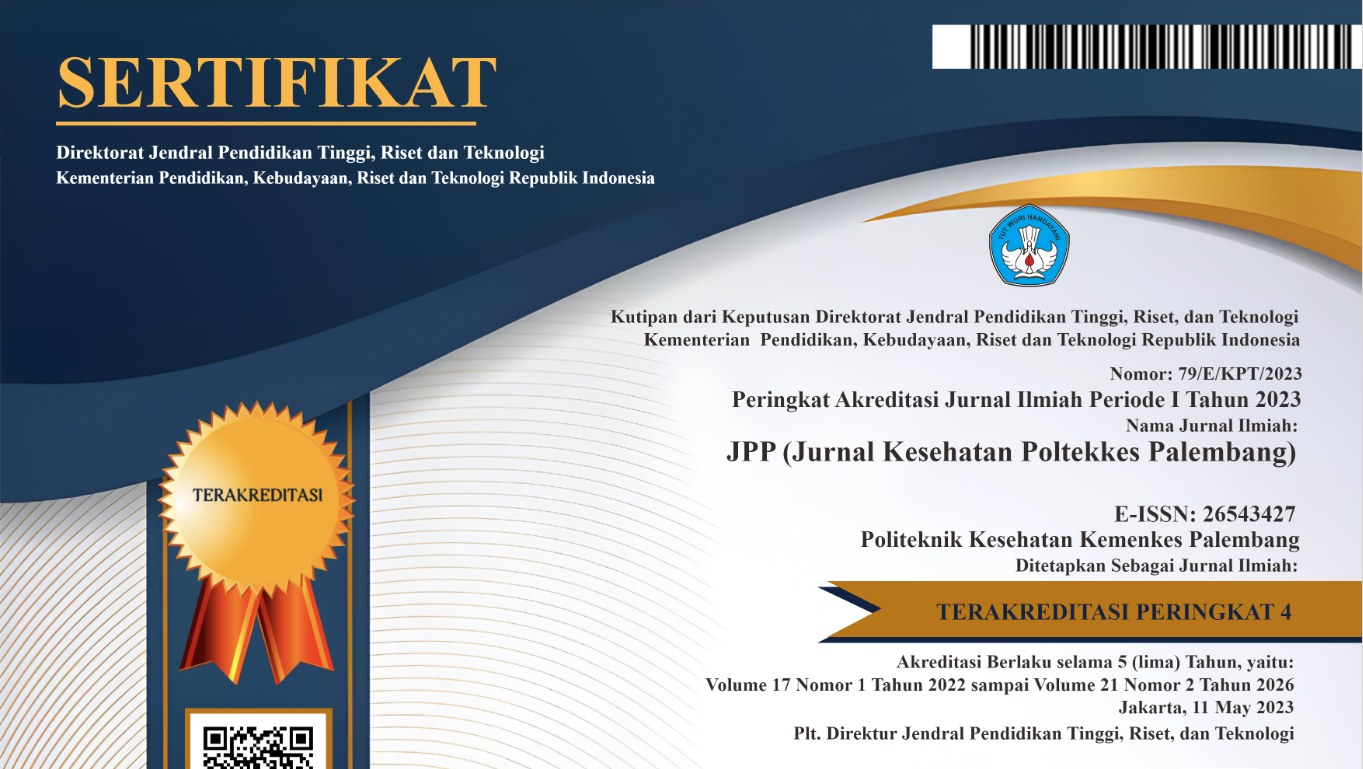

STATISTICS
INDEXED BY





ISSN & E-ISSN
TOOLS


SUPPORTED BY


JPP (Jurnal Kesehatan Poltekkes Palembang) is committed to integrity, transparency, objectivity, and accountability throughout the scholarly publication process. The journal recognizes that competing interests may influence, or reasonably appear to influence, the design, conduct, interpretation, evaluation, and publication of research.
JPP (Jurnal Kesehatan Poltekkes Palembang) requires authors, reviewers, editors, Editorial Board members, and relevant publishing personnel to disclose actual, potential, or perceived conflicts of interest that could affect research integrity or editorial independence.
A conflict of interest arises when professional judgment, research activities, or editorial responsibilities may be influenced, or reasonably perceived to be influenced, by another interest or relationship.
A competing interest does not necessarily indicate unethical conduct. However, failure to disclose a relevant interest may undermine transparency and confidence in the research or publication process.
Financial Conflicts of Interest
Relevant financial interests may include:
Research grants, sponsorships, or financial support from organizations interested in the findings;
Employment, consultancy fees, honoraria, or paid advisory roles;
Ownership of shares, intellectual property, or other financial interests;
Paid work for pharmaceutical companies, medical-device manufacturers, healthcare providers, government bodies, advocacy organizations, media organizations, or commercial entities relevant to the research; and
Financial benefits associated with the publication or application of the findings.
Non-Financial Conflicts of Interest
Relevant non-financial interests may include:
Personal, family, supervisory, or close professional relationships;
Academic competition, professional rivalry, or previous disputes;
Institutional affiliations or organizational responsibilities;
Leadership or active involvement in healthcare institutions, professional health organizations, or organizations directly concerned with the research topic; and
Editorial responsibilities or collaborations that could compromise independent judgment.
Personal, religious, philosophical, or theoretical views do not automatically constitute conflicts of interest. Disclosure is required when a relevant role, relationship, or commitment could reasonably affect the research or its evaluation. Authors are not required to disclose private beliefs unrelated to their work.
All authors must disclose relevant financial and non-financial interests during submission.
Authors must:
Identify relationships or interests relevant to the research;
Disclose funding, sponsorship, and relevant institutional or organizational support;
Explain sponsors' roles in research design, data collection, analysis, interpretation, manuscript preparation, and submission;
Ensure that disclosures accurately represent all co-authors;
Notify the Editorial Team of relevant changes during review or publication; and
Include a Conflict of Interest Statement in the manuscript, even when no relevant interests exist.
When No Conflict Exists
"The authors declare that they have no conflicts of interest related to the research, authorship, or publication of this article."
When a Conflict Exists
"Author A received research funding from [Organization Name]. Author B served as a consultant to [Organization Name] on matters relevant to this study. The remaining authors declare no conflicts of interest."
Funding must also be reported in the Funding Statement. Disclosure in one section does not replace a necessary explanation elsewhere.
A disclosed conflict does not automatically result in rejection. The editor will assess whether adequate safeguards and transparent reporting preserve the integrity of the work.
Reviewers must disclose relevant competing interests before accepting an assignment.
Potential conflicts include:
Personal or family relationships with authors;
Recent or ongoing research collaboration;
Supervisory or institutional relationships;
Direct professional competition or significant disputes;
Financial interests related to the findings; and
Roles in healthcare institutions, professional health organizations, or advisory bodies directly connected to the subject under review.
Reviewers must decline assignments when impartial assessment cannot reasonably be ensured. If a conflict becomes apparent after review has begun, they must promptly inform the handling editor and await instructions.
Under double-blind review, reviewers must not attempt to identify authors. If an author's identity becomes apparent and creates a potential conflict, the reviewer must notify the editor.
Confidential information obtained through peer review must not be used for personal, professional, financial, organizational, or other advantage.
Editors must base decisions on scholarly merit, originality, methodological quality, ethical compliance, and relevance to the journal's scope.
They must disclose interests that could affect manuscript handling, including:
Personal, professional, or supervisory relationships with authors;
Current or recent collaborations;
Relevant institutional or financial connections;
Direct competition or significant disputes;
Roles in healthcare institutions or professional health organizations relevant to the manuscript; and
Participation as an author or contributor.
Editors must recuse themselves when a relevant conflict could compromise independent judgment. The manuscript must then be assigned to another qualified editor without that conflict.
When the Editor-in-Chief has a conflict, responsibility must be delegated to an independent editor or appropriately qualified Editorial Board member.
Submissions from editors, Editorial Board members, or individuals connected to the publisher must receive independent assessment without preferential treatment.
JPP (Jurnal Kesehatan Poltekkes Palembang) maintains editorial independence from the financial, administrative, institutional, and organizational interests of its publisher, host institution, sponsors, and partners.
The following principles apply:
Institutional affiliation, financial contributions, and professional connections must not determine acceptance or rejection;
Authors affiliated with the publisher or host institution must meet the same standards as other authors;
Publication charges, advertisements, sponsorships, and commercial arrangements must not influence editorial decisions;
Editors and reviewers must remain free from inappropriate institutional, commercial, or other pressure; and
Relevant institutional interests must be disclosed and appropriately managed.
Initial Disclosure
Authors must provide relevant information at submission. Reviewers and editors must disclose interests before undertaking their respective responsibilities.
Editorial Assessment
The Editorial Team evaluates whether a disclosed interest could affect research integrity, reviewer impartiality, or editorial independence.
Management Measures
Depending on the circumstances, the journal may:
Request clarification or additional disclosure;
Appoint an independent handling editor;
Replace a reviewer;
Obtain an independent expert assessment;
Require a fuller explanation of funding or organizational relationships; or
Introduce additional safeguards proportionate to the concern.
Documentation
Relevant disclosures and management decisions will be recorded in the journal's editorial records.
Publication Transparency
Relevant author disclosures will appear in the published article. Confidential information will be protected during assessment, except where disclosure is necessary for publication transparency, ethical investigation, or applicable obligations.
Health research may involve relationships with organizations that are also research subjects, sponsors, employers, or beneficiaries.
Authors should disclose relevant relationships involving:
Hospitals, clinics, public health centers, and other healthcare providers;
Pharmaceutical companies and medical-device manufacturers;
Government health agencies and regulatory bodies;
Professional health organizations and medical associations;
Research institutes, laboratories, and diagnostic centers;
Non-governmental organizations and health advocacy groups;
Health insurers and health-financing organizations; and
Organizations whose policies, programs, or performance are being evaluated.
An insider role or participatory research relationship does not automatically invalidate a study. Authors should explain how the relationship affects access, recruitment, interpretation, and reporting, and describe safeguards against undue influence.
Researchers must protect voluntary participation, patient confidentiality, and accurate reporting. Sponsors or organizational partners must not improperly suppress unfavorable findings or require misleading conclusions.
Where disclosure could endanger participants or reveal protected health information, authors should consult the editor about an appropriate disclosure that preserves transparency without unnecessary identification.
When a potentially undisclosed interest is identified before or after publication, JPP (Jurnal Kesehatan Poltekkes Palembang) may:
Request an explanation and supporting documentation;
Assess its relevance to the research, review process, or editorial decision;
Consult independent experts or relevant institutions;
Require an updated declaration;
Publish a correction;
Issue an expression of concern when serious questions remain unresolved; or
Consider retraction when evidence establishes that the article's reliability or ethical integrity is fundamentally compromised.
Affected individuals will have a reasonable opportunity to respond.
Failure to disclose a competing interest does not automatically justify retraction. Any action must be proportionate to the nature and consequences of the omission.
Every published article must include a Conflict of Interest Statement.
When interests exist, the statement must identify the authors concerned and describe the relevant relationships clearly enough for readers to assess their significance.
When no relevant interests exist, an explicit declaration must be provided. Statements must be accurate and consistent with funding, affiliation, and contribution information elsewhere in the article.
Authors, reviewers, readers, and other concerned parties may report undisclosed or improperly managed interests through JPP (Jurnal Kesehatan Poltekkes Palembang)'s official editorial contact channels.
Reports should identify the article or editorial matter, explain the concern, and provide supporting evidence where available.
Appeals will be assessed fairly and, where appropriate, by an independent editor or qualified representative without a relevant conflict. Complaints concerning the Editor-in-Chief must be referred to an appropriate independent editorial or publishing representative.
JPP (Jurnal Kesehatan Poltekkes Palembang) applies this policy consistently across submissions, regardless of authors' institutional affiliations, academic positions, professional relationships, or financial circumstances.
This policy operates alongside the journal's Publication Ethics, Peer Review, Authorship and Contributorship, Allegations of Research Misconduct, and Corrections and Retractions policies.
SINTA
STATISTICS
INDEXED BY
ISSN & E-ISSN
TOOLS
SUPPORTED BY
Addressed Jalan Jend. Sudirman KM. 3.5 No 1365 Komplek RSMH Palembang, 30126
E-mail: jurnaljpp@poltekkespalembang.ac.id

JPP (Jurnal Kesehatan Poltekkes Palembang) is licensed under a Creative Commons Attribution-ShareAlike 4.0 International License.
