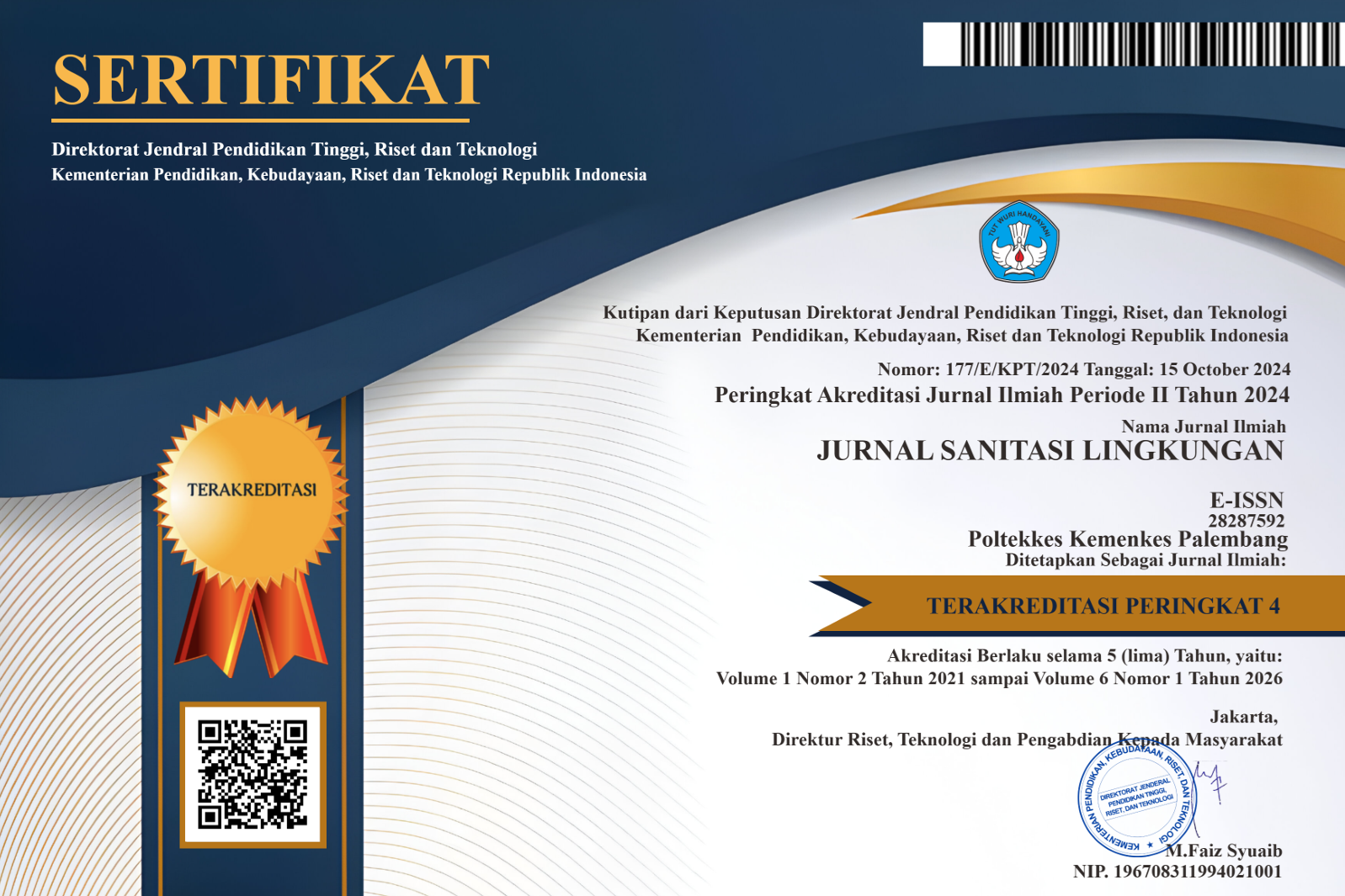
Electronic Filing
Jurnal Sanitasi Lingkungan publishes scholarly manuscripts that contribute to the advancement of knowledge in environmental sanitation, environmental health, and related public health disciplines. The journal welcomes original research, methodological studies, literature reviews, and other scientific contributions relevant to its Aim and Scope.
The journal covers water sanitation; residential and public area sanitation; air and soil sanitation; solid waste and wastewater management; vector control; occupational safety and health; environmental toxicology; food and beverage sanitation; environmentally related diseases; public health; and other topics directly related to environmental health and environmental protection.
Jurnal Sanitasi Lingkungan encourages interdisciplinary research that advances scientific knowledge, promotes evidence-based sanitation practices, supports environmental pollution prevention and control, and contributes to improving environmental quality and public health.
All manuscripts must be original, scientifically rigorous, ethically conducted, relevant to the journal's scope, written in Indonesian, and accompanied by abstracts in both Indonesian and English. Manuscripts must comply with the Jurnal Sanitasi Lingkungan Author Guidelines and Publication Ethics. All submissions are subject to initial editorial assessment and, if deemed suitable, peer review.
1. Original Research Article
Original Research Articles report original and previously unpublished empirical research that makes a significant contribution to environmental sanitation, environmental health, and related public health disciplines.
Jurnal Sanitasi Lingkungan welcomes research employing quantitative, qualitative, or mixed-methods approaches, including experimental, observational, cross-sectional, case-control, cohort, laboratory-based, field-based, and intervention studies, as well as other scientifically appropriate research designs.
An Original Research Article should generally include:
-
Abstract and Keywords;
-
Introduction;
-
Methods;
-
Results;
-
Discussion;
-
Conclusion; and
-
References.
The Results and Discussion sections may be combined where permitted by the journal's Author Guidelines.
Authors should clearly describe the research objectives, study design, sampling procedures, data collection methods, laboratory or field measurements, analytical techniques, and relevant environmental health indicators.
Studies involving human participants, biological materials, or environmental samples must comply with applicable research ethics, biosafety, and environmental regulations.
2. Systematic Review and Meta-Analysis
Systematic Review Articles provide rigorous, transparent, and comprehensive syntheses of existing scientific evidence addressing clearly formulated research questions relevant to environmental sanitation and environmental health.
This category may include systematic reviews, systematic reviews with meta-analysis, meta-analyses, scoping reviews, mapping reviews, and qualitative evidence syntheses, where appropriate.
Authors should clearly describe:
-
research questions and review objectives;
-
eligibility criteria;
-
databases and information sources;
-
search strategies and search dates;
-
study selection procedures;
-
data extraction methods;
-
methodological quality or risk-of-bias assessment, where applicable; and
-
methods of data analysis and evidence synthesis.
Reviews may address environmental pollution, sanitation interventions, water and air quality, waste management, vector control, environmental exposure, environmentally related diseases, and other topics within the journal's scope.
Authors should critically evaluate the quality, consistency, limitations, and implications of the available evidence. Manuscripts should follow recognized reporting guidelines, such as PRISMA or PRISMA-ScR, as appropriate to the review design.
3. Review Article
Review Articles provide comprehensive, critical, and balanced analyses of established or emerging topics in environmental sanitation, environmental health, and related public health research.
A Review Article should extend beyond a descriptive summary of previous studies by critically synthesizing scientific evidence, evaluating research developments, identifying knowledge gaps, and proposing directions for future research.
Relevant topics may include water and sanitation quality, environmental pollution, waste management, food hygiene and sanitation, vector control, occupational health and safety, environmental toxicology, environmental health risk assessment, and environmentally related diseases.
Review Articles should generally include:
-
Abstract and Keywords;
-
Introduction;
-
Relevant Thematic or Conceptual Subsections;
-
Critical Discussion;
-
Conclusion; and
-
References.
Authors should clearly explain the scope and basis of literature selection and provide a scientifically supported synthesis relevant to environmental health research and practice.
4. Conceptual and Theoretical Article
Conceptual and Theoretical Articles develop, examine, integrate, or critically evaluate concepts, theories, analytical frameworks, and models relevant to environmental sanitation and environmental health.
These articles may address environmental health risk assessment frameworks, sanitation management models, environmental exposure pathways, environmentally related disease prevention, community-based sanitation approaches, and sustainable environmental health interventions.
Manuscripts should present a clear and original scientific argument supported by relevant literature and established environmental health principles.
Conceptual and Theoretical Articles may propose:
-
new concepts or analytical frameworks in environmental sanitation;
-
theoretical models of environmental exposure and health risks;
-
integration or modification of existing environmental health theories;
-
critical evaluation of sanitation management and environmental health frameworks; and
-
context-specific approaches to environmental health protection and disease prevention.
Authors should demonstrate the scientific relevance, conceptual clarity, and potential application of the proposed framework to environmental health research, policy, or professional practice.
5. Methods and Measurement Article
Methods and Measurement Articles present significant methodological developments relevant to environmental sanitation and environmental health research.
These may include:
-
development and validation of environmental health and sanitation assessment instruments;
-
development and evaluation of environmental quality indicators and sanitation indices;
-
environmental sampling, monitoring, and measurement techniques;
-
assessment of water, air, soil, food sanitation, and waste management;
-
development and validation of laboratory and field testing methods;
-
environmental exposure and health risk assessment methods;
-
quantitative, qualitative, and mixed-methods approaches in environmental health research;
-
geospatial analysis, Geographic Information Systems (GIS), and environmental health mapping;
-
evaluation of sanitation interventions and environmental pollution control measures; and
-
adaptation and validation of environmental health measurement tools across different settings.
Manuscripts should clearly identify the methodological problem, describe the proposed approach, and demonstrate its scientific relevance through empirical evidence, practical applications, comparative analyses, or validation studies.
Instrument and measurement studies should explain the conceptual basis, parameter selection, sampling procedures, analytical methods, and relevant evidence of reliability, validity, accuracy, and precision.
Authors should address methodological transparency, reproducibility, quality assurance, and applicable ethical and environmental considerations.
6. Brief Research Report
Brief Research Reports present original empirical research or significant preliminary findings related to environmental sanitation and environmental health in a concise scientific format.
Suitable contributions may include preliminary environmental monitoring results, laboratory investigations, sanitation assessments, environmental exposure studies, evaluations of vector control interventions, and focused investigations of environmentally related health risks.
These manuscripts must meet the same scientific, methodological, and ethical standards required for full Original Research Articles. Preliminary findings should be clearly identified, and conclusions must reflect the limitations of the available evidence.
A Brief Research Report should generally include:
-
Abstract and Keywords;
-
Introduction;
-
Methods;
-
Results;
-
Discussion and/or Conclusion; and
-
References.
Authors should clearly describe the study's scientific contribution, methodological limitations, and implications for environmental sanitation and public health.
7. Perspective
Perspective Articles present evidence-based scholarly viewpoints on emerging issues, scientific developments, and challenges in environmental sanitation and environmental health.
These articles may examine emerging environmental health risks, sanitation technologies, environmental pollution prevention, climate-related environmental health challenges, waste management practices, occupational health hazards, and environmental health policies.
Perspectives should be scientifically grounded, analytically clear, academically balanced, and supported by relevant references.
Authors should critically examine available evidence, identify knowledge gaps, and present well-supported interpretations or recommendations for environmental health research, policy, and practice.
Unsupported opinions, promotional content, and arguments lacking adequate scientific evidence do not meet the requirements of this article type.
Global, Cultural, and Contextual Perspectives in Environmental Sanitation and Health Research
Jurnal Sanitasi Lingkungan recognizes that environmental sanitation and health issues are influenced by diverse environmental, geographical, socioeconomic, cultural, institutional, and climatic conditions. The journal encourages research that considers these factors and avoids inappropriate generalizations across different populations and environmental settings.
Jurnal Sanitasi Lingkungan encourages authors to:
-
incorporate local, national, international, or comparative perspectives on environmental sanitation and health;
-
recognize differences in environmental conditions, sanitation infrastructure, and public health challenges;
-
examine the influence of socioeconomic and environmental inequalities on sanitation access and health outcomes;
-
consider community practices and local environmental conditions in research design and interpretation;
-
evaluate the relevance of environmental health standards, assessment methods, and sanitation technologies;
-
promote evidence-based sanitation interventions and environmental pollution prevention; and
-
encourage interdisciplinary collaboration to address environmental sanitation and public health challenges.
The journal welcomes studies conducted in Indonesia and other countries, including comparative research relevant to environmental sanitation and health.
Research involving environmentally vulnerable communities, hazardous waste, environmental pollution, or occupational exposure must apply appropriate scientific methods, protect participant confidentiality, and comply with applicable ethical and environmental regulations.
Editorial Consideration
Acceptance of a manuscript category does not guarantee publication. All submissions are initially evaluated for relevance to the Aim and Scope of Jurnal Sanitasi Lingkungan, originality, scientific quality, methodological adequacy, ethical compliance, and contribution to environmental health knowledge.
The Editorial Team reserves the right to recommend manuscript reclassification when the content, methodology, or scientific contribution does not correspond to the article type selected during submission.
Authors must ensure that manuscripts are written in Indonesian, include abstracts in both Indonesian and English, and comply with the journal's Author Guidelines and Publication Ethics before submission.